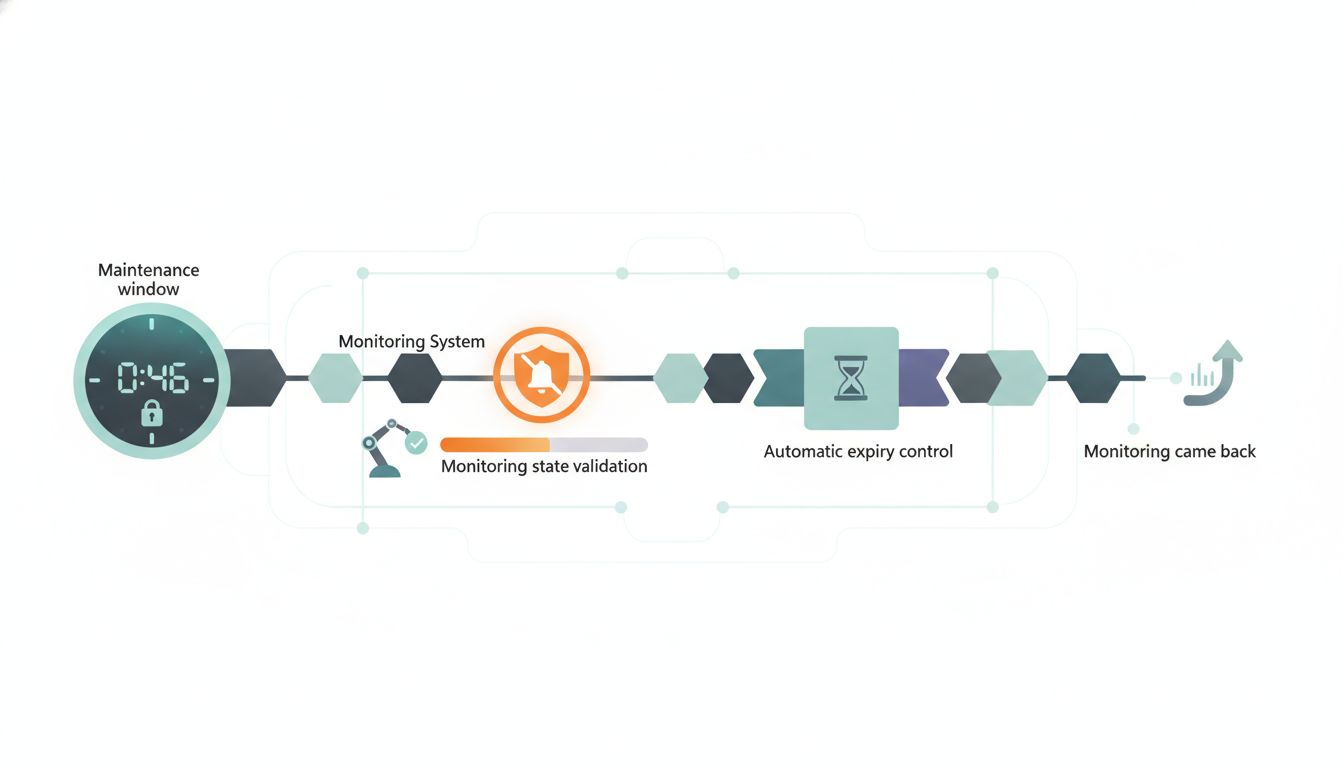
At 14:01, an anonymous server entered a maintenance window. At 14:47, the operation was closed with a “successful” result, while the same data recorded a parallel maintenance closure for another server.
That gives us a 46-minute window by the clock. It also gives us a neat green ending, which is exactly where an operator should become slightly suspicious.
The record tells me that the approved action completed. It does not tell me whether monitoring was actually muted for that server during the window. More importantly, it does not prove that monitoring became active again when the window ended.
What the record actually proves
There are three different states hiding inside one apparently simple maintenance task.
The first is the workflow state: someone or something requested maintenance, the request was approved, and the closing operation returned “successful.” This is the part we can see in the available data.
The second is the monitoring state during maintenance. Was the server truly excluded from alert processing, or did alerts continue to flow while the approved work was under way? The record contains no verification step for that condition.
The third is the state after maintenance. Did the monitoring platform remove the suppression and restore normal alerting? Again, there is no recorded check.
“Successful” described the workflow result. It did not prove the monitoring state.
I would not report an outage from this case because none was recorded. I would not attach a cost, an impact duration, or a missed incident to it either. Those facts are absent, and inventing them would turn an operational lesson into fiction.
What I can say is that the evidence stops too early. The process records intent and completion, but not the final condition we actually care about.
The missed signal
The missing signal is not another notification saying that the maintenance task closed. It is a direct state check asking whether alerting for that server is active again.
A close command and an active monitoring state are separate facts. The first can succeed while the second remains wrong. If the workflow talks to another system, a successful response may only mean that a request was accepted or processed. It does not automatically prove that every monitored object returned to its expected state.
The parallel closure on another server makes the distinction worth examining. There is no evidence that the two operations interfered with each other, so I will not claim that they did. But parallel activity is one more reason to validate each target independently rather than trusting a batch-level result.
For this server, the useful post-maintenance metric would have been simple: suppression state equals off, monitoring state equals active, and a test signal can travel through the expected alert path. None of those confirmations appears in the available record.
What happens if maintenance does not expire?
Consider the operational sequence, without pretending it happened in this case. Approved work finishes, the maintenance workflow closes, and the dashboard reports success. The server, however, remains suppressed in the monitoring platform.
A genuine condition can then occur after the approved window. The monitoring platform may still collect the metric, or it may continue evaluating the check, but the resulting notification remains muted because the maintenance state never cleared.
The dangerous part is the silence. There may be no failed automation ticket because the closing workflow believes it succeeded. There may be no active maintenance task because that task is already complete. The server sits between two truths: the workflow says closed, while monitoring behaves as though maintenance continues.
This is why I do not treat a maintenance window as a timer attached to a calendar entry. It is a temporary exception to the alerting policy. An exception needs a defined owner, an approved end time, and proof that the exception was removed.
If the maintenance window remains open, the next genuine alarm can be silent. If it closes too early, expected maintenance noise can reach the operations team. Both are failures, even though only one tends to produce an impressive pile of tickets.
Why nobody sees the gap
The technical reason is a missing feedback loop. The process sends a state-changing command and records the command result, but it does not read the target state afterward. This is command confirmation, not state validation.
The human reason is less technical and more familiar. Operators see an approved task, a closing timestamp, and a successful result. Under normal workload, that looks finished. We have trained ourselves to follow the red items, so a green line rarely receives an interrogation.
The wording also matters. “Maintenance closed successfully” sounds stronger than “the closure operation completed.” The first suggests an end-to-end truth. The second describes only what the workflow knows.
There is another ownership problem. The team performing maintenance may own the work, while another platform owns monitoring suppression. If neither side is explicitly responsible for verifying the restored alert state, success falls into the gap between them. Everyone completed a task; nobody confirmed the service was watchable again.
That is the absurd little trap here. We carefully silence monitoring so maintenance does not wake people unnecessarily, then risk leaving it silent when waking people becomes necessary.
A maintenance window closure checklist
- Record a mandatory expiry time when maintenance begins. Do not allow an indefinite suppression unless it has a separately approved control and owner.
- After closure, query the monitoring platform directly and verify that suppression is removed for every affected server, service, and check.
- Confirm alert delivery with a safe test signal or an equivalent end-to-end validation. A status field alone does not prove that the notification path works.
- Create an exception for any maintenance state that survives beyond its approved end time. Route it to a named operational owner rather than leaving it as an informational event.
- Reconcile parallel maintenance operations per target. A successful batch or workflow result must not replace validation of each server’s final monitoring state.
I would also keep the evidence together: opening time, approved end time, actual closure time, target monitoring state, validation result, and owner. That turns a maintenance record into an auditable control rather than a diary entry.
The available case data gets the first part right. The window was opened, approved, and closed, and the activity was recorded. The missing part is proof that the temporary monitoring exception ended with it.
On Monday, add a post-expiry check that verifies monitoring is active again and escalates every maintenance window that outlives its approval.
Kaynaklar
- No external URLs were used. This anonymised case is based solely on the author-supplied operational notes, reviewed 12 October 2026.